How tennis scoring works confuses almost every new fan at first. The umpire calls “love-fifteen.” Then the score jumps to thirty and forty. After that, someone says “deuce,” and the match seems to stop making sense. However, the system is simple once you see the pattern. In this guide, you will learn how tennis scoring works from the first point to the final handshake. You will also see the rules for tiebreaks, doubles, and Grand Slam finals.
If you follow live coverage on Sports Tamasha, Sports News Era, or Sports Dastak, this article will help you read every scoreboard with confidence.
Quick Answer: How Tennis Scoring Works in 30 Seconds
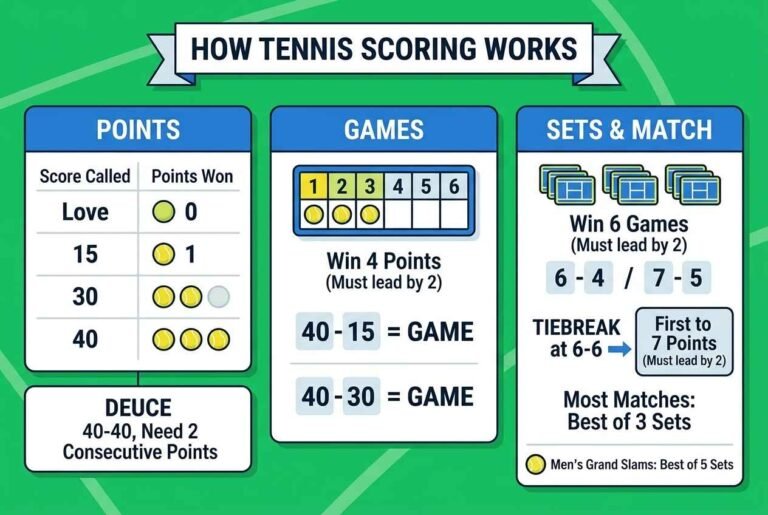
Tennis uses three layers of scoring: points, games, and sets. Players win points to win games. Then they win games to win sets. Finally, they win sets to win the match. Here is the short version.
- Points: 0 (love), 15, 30, and 40 are the four steps inside one game.
- Game: A player wins a game by taking four points with a lead of at least two points.
- Set: A player wins a set by taking six games with a lead of at least two games. If the score reaches 6-6, most sets go to a tiebreak.
- Match: Most matches are best of three sets. Men’s Grand Slam matches are best of five sets.
In short, the tennis scoring system rewards consistency. A player must keep winning important points over a long match. Luck alone rarely works.
Table of Contents
- The Three Levels of Tennis Scoring
- How Points Work: Love, 15, 30, 40
- Why Tennis Uses 15, 30, and 40
- Deuce and Advantage Explained
- How Games and Sets Work
- Tiebreak Rules Step by Step
- Match Formats: Best of Three vs Best of Five
- Grand Slam Final Set Rules
- No-Ad Scoring
- How Tennis Scoring Works in Doubles
- How Umpires Call the Score
- A Full Example, Point by Point
- Who Serves and When Players Change Ends
- Famous Long Matches
- Common Scoring Mistakes
- Tennis Scoring Glossary
- FAQ: Tennis Scoring Questions
The Three Levels of Tennis Scoring
To understand how tennis scoring works, start with the structure. Every match has three levels. Each level sits inside the next one, like boxes inside a bigger box.
Level 1: Points
A point starts when a player serves. It ends when one player cannot return the ball inside the court. The ball may go out. It may hit the net. It may bounce twice. In every case, one player wins the point.
Level 2: Games
Points add up to games. One player serves for the whole game. Then the other player serves the next game. So the serve alternates every game.
Level 3: Sets and the Match
Games add up to sets. Sets add up to the match. Because of this structure, a player can win fewer total points than the opponent and still win the match. That surprises many beginners. Nevertheless, it is completely normal in professional tennis.
For example, a player might lose a set 6-0 and still win the match 6-0 in the next two sets. The match winner is the player who wins the required number of sets. Total points do not decide it.
How Points Work: Love, 15, 30, 40
The point system is the part that looks strange. Instead of counting 1, 2, 3, 4, tennis uses a special sequence. The table below shows how tennis scoring works inside a single game.
| Points won | Score called |
|---|---|
| 0 points | Love |
| 1 point | 15 |
| 2 points | 30 |
| 3 points | 40 |
| 4 points (with a two-point lead) | Game |
Notice one detail. The sequence has gaps. The jump from 30 to 40 is only ten, while the others are fifteen. Yet the system still works, because the numbers are labels. They are not real math. Each label simply means “one more point won.”
What Does “Love” Mean?
“Love” means zero. So a score of “love-thirty” means the server has zero points and the returner has thirty. The server’s score is always called first. Many people say the word comes from the French l’œuf, which means “egg.” An egg looks like a zero. However, historians still debate this idea, so treat it as a popular theory.
How to Read Common Scores
- 15-love: The server has one point. The returner has none.
- 30-15: The server has two points. The returner has one.
- 40-30: The server has three points. The returner has two.
- 15-all: Both players have one point.
- 30-all: Both players have two points.
Note that tennis says “all” instead of repeating the number. So you hear “fifteen-all,” not “fifteen-fifteen.” Also, at three points each, the umpire says “deuce,” not “forty-all.”
Why Tennis Uses 15, 30, and 40
Nobody knows the exact origin. Even so, several theories exist. Because the question appears in so many searches, it deserves a short answer here.
The first theory links the numbers to a clock face. Early scorekeepers may have moved a clock hand to 15, 30, 45, and 60. Over time, 45 shortened to 40 because “forty” is quicker to say than “forty-five.” This idea is popular in many tennis books.
A second theory says the numbers came from old French coin values. A third theory links them to medieval games that used quarter turns. Sadly, none of these ideas has full proof.
The important point is simple. The odd numbers are tradition. Today, the International Tennis Federation, or ITF, keeps the official Rules of Tennis. Every professional event follows that base system.
Deuce and Advantage Explained
Deuce is the most misunderstood word when people ask how tennis scoring works. Fortunately, the rule is easy.
What Is Deuce?
Deuce happens when both players reach 40-40. At that moment, neither player can win the game with the next point. A player must win by two clear points. So the game continues.
What Is Advantage?
After deuce, the player who wins the next point gets “advantage.” The umpire says “advantage server” or “advantage receiver.” Advantage means that player is one point from winning the game.
Then two things can happen:
- The player with advantage wins the next point. That player wins the game.
- The opponent wins the next point. The score returns to deuce.
Because of this rule, a game can go back and forth many times. Some deuce games last twenty points or more. As a result, they are often the most exciting moments in a match.
Advantage Notation on Scoreboards
Digital scoreboards show advantage as “AD” next to the player’s name. Meanwhile, the other player shows 40. When the score returns to deuce, both players show 40 again.
How Games and Sets Work
Now that you know how tennis scoring works inside one game, let us zoom out to sets. This part of how tennis scoring works decides who leads the match.
Winning a Game
A player wins a game by winning four points with a two-point lead. So 40-0, 40-15, and 40-30 all end with one more point. But 40-40 does not.
Winning a Set
A player usually wins a set by reaching six games with a two-game lead. Here are the normal set scores:
- 6-0, 6-1, 6-2, 6-3, and 6-4 are all clean wins.
- 7-5 happens when the score reaches 5-5 and one player wins two games in a row.
- 7-6 happens after a tiebreak at 6-6.
Therefore, a set cannot end 6-5. The winner needs to be ahead by two games, or win a tiebreak.
How Set Scores Appear on TV
On television, the scoreboard lists completed sets first. Then it shows the current game score. For instance, “6-4, 3-2, 30-15” means the first set finished 6-4. In the second set, one player leads 3-2. In the current game, the score is 30-15.
Tiebreak Rules Step by Step
A tiebreak is a special mini-game. It decides a set when the score reaches 6-6. Without it, sets could last for hours. Many fans want a full guide on this topic, so here are the tiebreak rules in order.
Standard Set Tiebreak (First to 7)
- Players count points normally: 1, 2, 3, and so on. There is no “love” or “15” in a tiebreak.
- The first player to reach 7 points wins the tiebreak, if that player leads by two points.
- If the score reaches 6-6 in the tiebreak, play continues until one player leads by two.
- The winner of the tiebreak wins the set 7-6.
Who Serves in a Tiebreak?
Serving rules in a tiebreak are unique. Follow this pattern:
- The player who is due to serve starts. That player serves one point.
- Then the opponent serves the next two points.
- After that, the players alternate every two points.
This pattern keeps the tiebreak fair. Each player gets a similar number of serves from each side of the court.
When Do Players Change Ends in a Tiebreak?
Players change ends after every six points. As a result, both players face the same wind and sun conditions over time. There is no long break at these changes. Players simply switch sides and continue.
After the Tiebreak
The player who received first in the tiebreak serves first in the next set. Consequently, the serve order continues in a balanced way.
Match Formats: Best of Three vs Best of Five
The number of sets changes with the event. Knowing the format is a key part of how tennis scoring works.
Best of Three Sets
A player must win two sets to win the match. This format is used in most professional events. Women’s matches use it at every level, including Grand Slams. Men’s tour events also use it.
Best of Five Sets
A player must win three sets to win the match. Men’s Grand Slam singles matches use this format. Because of this, they can last four or five hours. Players need excellent fitness to survive.
Other Formats
Some events use shorter formats to save time. For example, exhibition events may use “Fast4” rules. That system uses first-to-four game sets and no-ad scoring. Junior and club matches also vary. So always check the event rules first.
Grand Slam Final Set Rules
The four Grand Slams are the Australian Open, the French Open, Wimbledon, and the US Open. They are the biggest events in the sport. Each has its own history with the final set.
Years ago, some Slams let the final set continue until one player led by two games. That rule created huge scores. Later, the tournaments moved toward tiebreaks. Today, the Slams use a 10-point tiebreak at 6-6 in the deciding set. The first player to reach 10 points, with a two-point lead, wins the match.
Rules can change, so check the official pages before a tournament. Here are the official sites:
Fans who track results daily can also use Sports News Era for quick sports updates during the major tournaments.
No-Ad Scoring
No-ad scoring is a shortcut version of the game rules. It removes the long deuce battles. Here is how it works:
- Players play normally until the score reaches 40-40.
- Then one deciding point is played.
- The receiver chooses which side to receive the serve.
- Whoever wins that point wins the game.
Organizers use no-ad scoring to shorten matches. It is common in college tennis, and in many doubles events on the pro tours. Still, singles at the top level normally use the traditional deuce and advantage system.
The deciding point creates tension. Because of this, fans often enjoy it. Yet some players dislike it, because it reduces the value of a long fight.
How Tennis Scoring Works in Doubles
Doubles uses the same point, game, and set system as singles. However, there are a few differences. Understanding them helps you follow team matches.
The Court Is Wider
Doubles uses the outer side lanes, called the alleys. So the court becomes wider. The scoring is unchanged, but the rally patterns are very different.
Serving Order
Each team has two players. Partners take turns serving whole games. For example, Player A serves the first game for Team 1. Then a player from Team 2 serves. After that, Player B serves for Team 1. The order stays the same for the whole set.
Match Tiebreak Instead of a Third Set
Many doubles events skip the final set. Instead, they play a 10-point match tiebreak when each team wins one set. The first team to reach 10 points, with a two-point lead, wins the match. This format saves time, and it keeps top singles players willing to play doubles.
Mixed Doubles
Mixed doubles has one man and one woman on each team. The scoring rules are the same as regular doubles. Each event may choose no-ad scoring or a match tiebreak, so check the format before you watch.
How Umpires Call the Score
A chair umpire announces the score after every point. Knowing the calling style makes it easier to follow the game. Here are the main rules.
- The server’s score is called first. So “thirty-fifteen” means the server has 30.
- Equal scores use the word “all,” such as “fifteen-all.”
- Three points each is “deuce.”
- After a game, the umpire says “Game, Player X,” and gives the set score.
- After a set, the umpire says “Set, Player X,” and gives the sets total.
- At the end, the umpire says “Game, set, match.”
In addition, umpires call “fault” for a bad serve and “let” for a serve that touches the net cord but lands in. Neither call changes the score by itself. A second fault, called a double fault, gives the point to the returner.
A Full Example, Point by Point
An example makes the rules easy to remember. Imagine that Alex serves against Sam. Here is one full game.
- Alex wins the first point. The score is 15-love.
- Sam wins the next point. The score is 15-all.
- Alex wins again. The score is 30-15.
- Alex wins again. The score is 40-15.
- Sam wins a point. The score is 40-30.
- Sam wins another point. The score is deuce.
- Alex wins the next point. The score is advantage Alex.
- Sam wins the next point. The score returns to deuce.
- Alex wins two points in a row. Alex wins the game.
Now Alex leads 1-0 in games. Sam serves the next game. This pattern repeats until one player wins the set.
A Short Set Example
Suppose the game score in a set goes 1-0, 1-1, 2-1, 2-2, 3-2, 3-3, 4-3, 4-4, 5-4, 5-5, 6-5, 6-6. At 6-6, the players play a tiebreak. Then the tiebreak winner wins the set 7-6. That is how tennis scoring works in a close set.
Who Serves and When Players Change Ends
Serving is a major part of the scoring flow. So let us review the basic rules.
The Opening Toss
Before the match, the players do a coin toss. The winner of the toss chooses to serve, to receive, or to pick the side of the court. Then the opponent gets the remaining choice.
Alternating Games
Servers change after every game. As a result, each player serves about half of all games. Servers also alternate sides of the court after each point. First they serve from the right side, and then from the left.
Changeovers
Players change ends after the first game, and then after every two games. That means after games 1, 3, 5, and so on. Players get a short break of about 90 seconds at these changeovers. After each set, the break is a little longer.
Two Serves
A server gets two attempts on each point. If both fail, the server loses the point. This rule creates the “double fault.” Because of it, many players take more risk on the first serve and play safer on the second.
Famous Long Matches and How Tennis Scoring Works Under Pressure
The scoring system can produce amazing matches. The best example is John Isner versus Nicolas Mahut at Wimbledon in 2010. At that time, Wimbledon had no final-set tiebreak. The players had to keep going until one led by two games.
The match lasted 11 hours and 5 minutes over three days. Isner won the fifth set 70-68. This match led to the later changes in final-set rules. Even today, fans consider it the longest match in tennis history.
This story shows why the deciding-set rule matters. It also shows how tennis scoring works when a set has no tiebreak. Without that safety valve, the match can keep going for a very long time.
Common Scoring Mistakes
Beginners often make the same errors. Avoid these to understand how tennis scoring works faster.
- Thinking 40 is 40 points. It is only the third point won.
- Forgetting the two-point rule. Winning four points is not enough if the score is close.
- Calling “40-40” instead of “deuce.” Umpires always say deuce.
- Mixing up server and returner. The server’s score always comes first.
- Using normal points in a tiebreak. A tiebreak counts 1, 2, 3, and so on.
- Believing the player with more points wins. The match winner wins sets, not total points.
Tennis Scoring Glossary
Love
A score of zero.
Deuce
A 40-40 tie inside a game.
Advantage
The next point after deuce, which puts a player one point from the game.
Break of serve
A win by the returner in the server’s game.
Hold
A win by the server in the server’s own game.
Tiebreak
A special game to decide a set at 6-6.
Match tiebreak
A 10-point game that replaces a final set.
Bagel
A set that ends 6-0.
Breadstick
A set that ends 6-1.
Double fault
Two failed serves in a row, which loses the point.
Ace
A serve that the returner cannot touch.
Set point
A point that can win the set.
Match point
A point that can win the match.
Break point
A point that can win a game against the server.
Why Break Points Matter in How Tennis Scoring Works
Serving gives a natural edge. So a “break of serve” is a big moment. When a player breaks, that player wins a game the opponent was expected to win. Often, one break is enough to win a whole set.
As a result, commentators talk about break points all the time. Here is how it changes the score:
- At 30-40 on serve, the returner has a break point.
- At deuce, a break point appears when the returner wins the next point.
- At 4-5 in a set, the server faces a set point against them.
Because of this, many players track “break points saved” and “break points converted.” These statistics reveal who handles pressure best. You can see them on the official tour pages, such as ATP Tour and WTA Tennis.
Tips to Understand How Tennis Scoring Works Live
You now know how tennis scoring works. Here are a few habits that will help you follow matches better.
- Watch the server’s name. The scoreboard usually shows a small dot or ball next to the server.
- Read the set scores from left to right. The order shows the match story.
- Count break points. They show where the match may turn.
- Check the format. Ask if the match is best of three or best of five.
- Follow reliable news sites. For example, Sports Dastak and Sports Tamasha publish daily sports coverage and match updates.
Over time, you will not need the scoreboard at all. You will feel the pressure points as a match unfolds.
How Tennis Scoring Works for Casual and Club Players
Friendly matches do not need to follow every pro rule. Still, most clubs keep the base system. Here are a few common variations.
- Short sets: First to four games, with a tiebreak at 3-3 or 4-4.
- Pro sets: One long set to eight games.
- Match tiebreak: A 10-point game in place of the third set.
- No-ad scoring: Used to save time on busy courts.
Before you play, agree on the format with your opponent. That step avoids arguments, and it keeps the match fun. Also remember that players call the score out loud, and the server usually announces it before each point.
How Tennis Scoring Works and Shapes Strategy
Knowing how tennis scoring works also explains how players think. For example, the first point of a game feels less important than a break point. So smart players save their best shots for key moments. Here are some common patterns:
- Servers often go for big serves at 30-40.
- Returners take more risks at 15-40.
- Players often play safer at 40-0, because a mistake costs little.
- At deuce, many players choose the highest-percentage pattern they trust.
This is why tennis feels like a mental game as much as a physical one. Every score creates a different level of pressure.
Tennis Scoring vs Other Racket Sports
Tennis scoring is unique, and learning how tennis scoring works helps with other sports too. It has similarities with other sports. Badminton and table tennis use simple point counts. Squash and pickleball use games to a set total. Padel, however, uses the same 15-30-40 system as tennis.
So if you understand how tennis scoring works, you can pick up padel quickly. The main difference is the shorter court and the walls. Both sports use deuce, advantage, and sets.
FAQ: How Tennis Scoring Works
How does tennis scoring work for beginners?
Players win points to win games, games to win sets, and sets to win the match. Points go 0 (love), 15, 30, 40, and then game. A player must win a game by two clear points. A player must win a set by two clear games, or by winning a tiebreak.
Why is tennis scored 15, 30, 40?
The exact origin is unknown. The most common theory says early scorers used a clock face with 15, 30, 45, and 60. Later, 45 became 40. It is a tradition that has lasted for centuries.
What does love mean in tennis?
Love means zero. “Fifteen-love” means the server has 15 and the opponent has zero.
What is deuce in tennis?
Deuce means the game is tied at 40-40. A player must win two points in a row from deuce to win the game. The first of those two points gives that player “advantage.”
How many sets are played in a tennis match?
Most matches are best of three sets. Men’s Grand Slam singles matches are best of five sets. So the winner needs either two or three sets.
How does a tiebreak work in tennis?
A tiebreak starts at 6-6 in a set. Players count points as 1, 2, 3, and so on. The first player to reach 7 points, with a two-point lead, wins the set. The server changes after the first point, and then after every two points.
What is a match tiebreak?
A match tiebreak is a 10-point tiebreak played instead of a full final set. It is common in doubles. The winner is the first player or team to reach 10 points with a two-point lead.
What is no-ad scoring?
No-ad scoring removes advantage. At 40-40, one deciding point decides the game. The receiver picks the side to return the serve.
Can a player win a match with fewer total points?
Yes. The winner is the player who wins the required number of sets. Because of the game and set structure, a player can win fewer points overall and still win the match.
Who serves first in a tennis match?
The coin toss decides. The winner chooses to serve, to receive, or to pick a side. The opponent then chooses from what remains.
Is tennis scoring different for men and women?
The scoring system is the same. The main difference is the match length at Grand Slams. Women play best of three sets, and men play best of five.
How long can a tennis match last?
It depends on the rules. Modern tiebreak rules limit the length. However, the 2010 Wimbledon match between Isner and Mahut lasted 11 hours and 5 minutes because there was no final-set tiebreak at that time.
Final Thoughts: Master How Tennis Scoring Works
You have now seen how tennis scoring works from the ground up. Points become games. Games become sets. Sets decide the match. Deuce and advantage add drama, and tiebreaks keep sets from running forever.
Remember the key points:
- Points go love, 15, 30, 40, game.
- A game needs a two-point lead.
- A set needs six games with a two-game lead, or a tiebreak at 6-6.
- Most matches are best of three sets, and men’s Slams are best of five.
- Doubles and casual play may use no-ad scoring or a match tiebreak.
The next time you watch a match, listen to the umpire and follow the scoreboard. Soon it will feel natural. For more sports guides, live coverage, and news, visit Sports Tamasha, Sports News Era, and Sports Dastak.