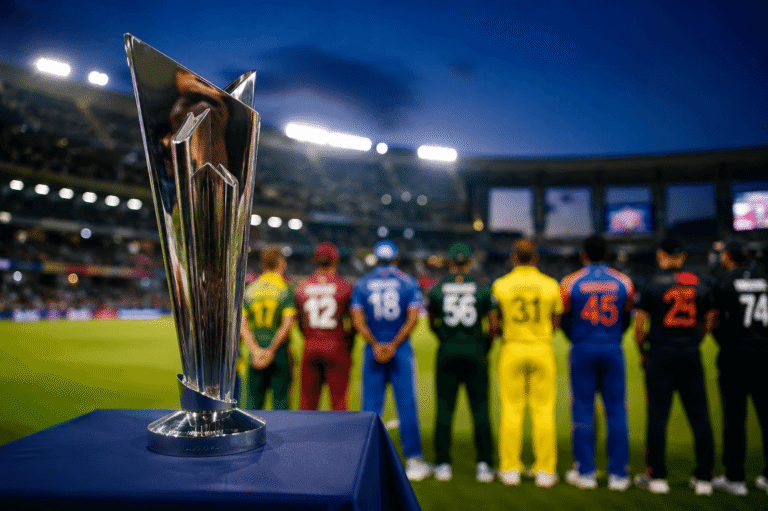

The ICC T20 World Cup is the pinnacle event of the shortest international format, bringing together the best T20 sides from across the globe in a tournament built for fast, high-scoring, unpredictable cricket. Since its launch in 2007, the tournament has grown from a modest experiment into one of the most-watched events in world sport, expanding its participant field to include more Associate nations and giving smaller cricketing countries a genuine stage against the game’s traditional powerhouses. This guide covers the format, qualification pathway, and what makes the T20 World Cup such a compelling tournament to follow.
Tournament Format and Structure
The modern T20 World Cup typically begins with a group stage involving all qualified teams split into pools, with the top finishers from each group advancing to a Super stage or direct knockout rounds depending on the edition’s format. Because T20 cricket is inherently high-variance, with a single over capable of shifting a match completely, group-stage upsets are common, and even top-ranked teams have been eliminated early in several past editions. This unpredictability is part of what makes the tournament so widely followed, since no team can be considered safe until the trophy is actually lifted.
Expanded Participation and Associate Nations
Recent editions of the T20 World Cup have expanded the number of participating teams, opening the door for Associate nations such as Namibia, Scotland, Uganda, and the USA to compete on the same stage as India, Australia, and England. This expansion has produced some of the tournament’s most memorable moments, including upset wins by Associate sides over established Full Member nations, and has been credited with accelerating the growth of T20 cricket in emerging markets.
Qualification Pathway
Qualification for the T20 World Cup runs through a mix of automatic qualification for top-ranked teams and a separate global qualifying tournament for the remaining spots. Regional qualifiers across Africa, the Americas, Asia, Europe, and East Asia-Pacific feed into this global qualifying event, meaning a nation’s road to the World Cup can start years in advance through regional competition that rarely gets international broadcast coverage but matters enormously to the nations involved.
Key Storylines Fans Should Track
Beyond the obvious question of who lifts the trophy, fans following the T20 World Cup closely tend to track a handful of recurring storylines: which top-order batters are scoring quickest given the format’s premium on strike rate, which death-overs bowlers are containing runs most effectively under pressure, and which underdog teams are punching above their pre-tournament ranking. Powerplay performance, both with bat and ball, is often the single strongest predictor of which teams go deep into the knockout stages.
Venue and Conditions Impact
Because the T20 World Cup rotates host nations, conditions can vary dramatically between editions, from batting-friendly pitches that produce 200-plus totals to slower, more bowler-friendly surfaces where 140 becomes a competitive score. Teams that adapt their squad composition and batting approach to suit host conditions, rather than relying purely on a template built for their home conditions, have historically performed better across the tournament.
Frequently Asked Questions
How many teams compete in the T20 World Cup?
Recent editions have expanded the field, with more Associate nations qualifying alongside the established Full Member cricket nations.
How does a team qualify for the T20 World Cup?
Qualification runs through a mix of automatic qualification based on rankings and a separate global qualifying tournament fed by regional qualifiers.
Why is the T20 World Cup considered less predictable than other formats?
The short format means a small number of overs can decide a match, making upsets far more common than in ODI or Test cricket.
Conclusion
The ICC T20 World Cup has become a genuine showcase for the growth of the shortest format worldwide, blending elite contests between established powers with breakout moments from emerging cricketing nations. Tracking the group stage, powerplay trends, and qualification storylines gives fans the clearest picture of how the tournament is likely to unfold.
The Role of Player Auctions and League Experience
Unlike ODI and Test cricket, many players entering the T20 World Cup arrive with recent experience from major domestic T20 leagues around the world, from the IPL to the Big Bash to the PSL. This cross-pollination of leagues means players often walk into the World Cup having faced international-standard bowling attacks and batting lineups just weeks earlier, which selectors increasingly factor into squad selection, favoring players in current white-ball form over those with strong records in longer formats alone.
Captaincy and In-Match Tactics
Given how quickly momentum shifts in T20 cricket, captaincy decisions carry outsized weight at the World Cup. Choices around bowling order, field placements during the powerplay, and when to deploy a team’s premier death-overs bowler are dissected extensively by fans and analysts alike, since a single tactical misstep in a 20-over match can be far harder to recover from than the equivalent mistake in a 50-over game.
Weather and Scheduling Considerations
Because the T20 World Cup is often played across multiple host cities and sometimes multiple countries, weather interruptions and the Duckworth-Lewis-Stern method for rain-affected matches have played decisive roles in several editions. Reserve days for knockout matches have become standard in recent tournaments specifically to reduce the chance of a marquee fixture being decided without a full match being played.
All of this adds up to a tournament where preparation, adaptability, and a bit of luck with conditions and the draw combine to decide who ultimately lifts the trophy, which is exactly why the T20 World Cup remains must-watch cricket for casual and hardcore fans alike.
For fans planning their viewing schedule around the tournament, keeping track of the fixture list, time zone conversions, and each team’s net run rate situation heading into the final group games is the easiest way to avoid missing the matches that end up mattering most.
That level of attentiveness is exactly what separates a casual viewer from a fan who actually sees a T20 World Cup title race coming together weeks before it becomes obvious to everyone else.
It rewards patience over the group stage and pays off with some of the most thrilling knockout cricket the format has to offer.