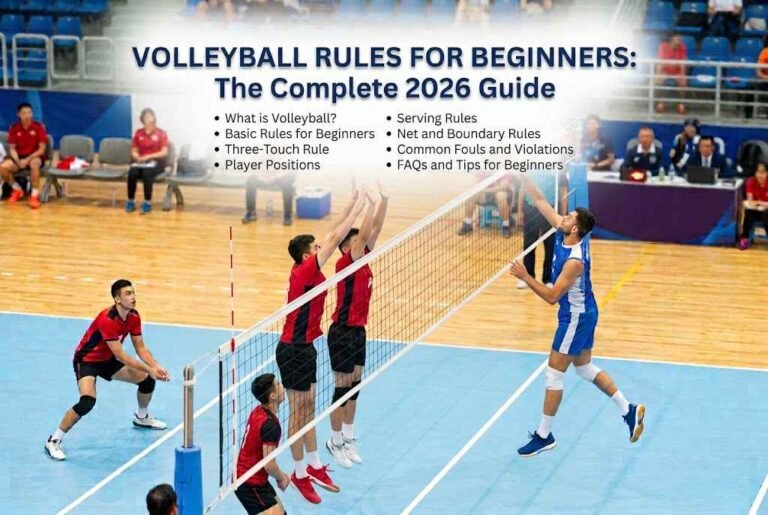
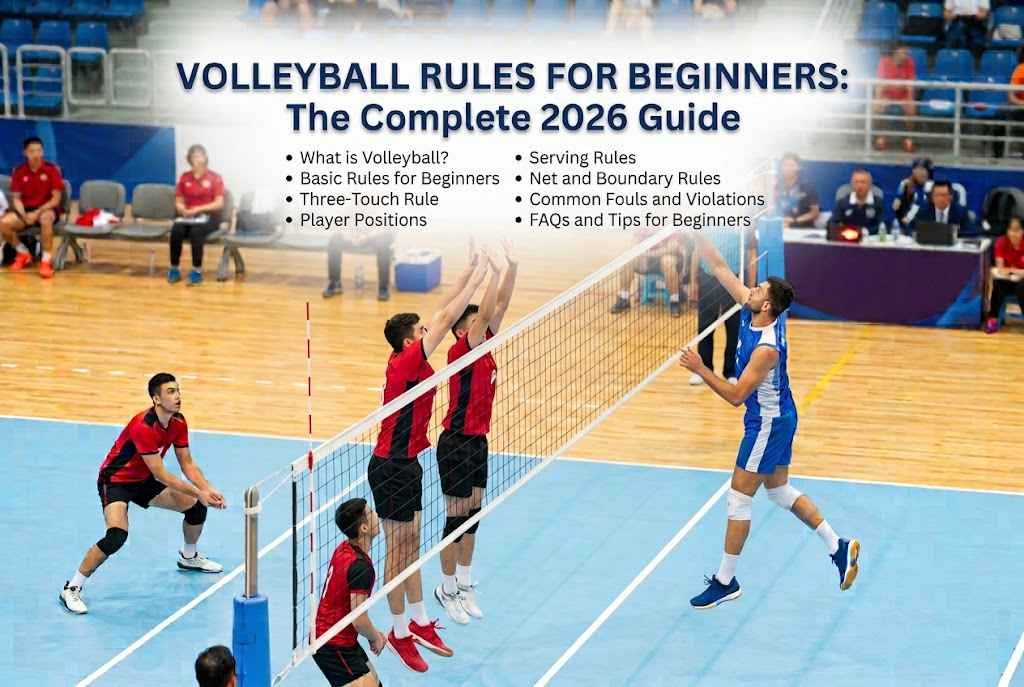
If you are just starting out and searching for volleyball rules for beginners, this guide will make everything simple and clear. Volleyball looks easy to watch, but once you start playing, the rules around rotations, scoring, touches, and positions can feel confusing at first. The good news is that once you understand the basics, volleyball becomes one of the most fun and easy-to-learn team sports in the world.
In this complete guide, we will break down every essential volleyball rule for beginners — from how a match is scored, to player positions, rotations, common fouls, and even a few match-day tips. Whether you are planning to play in school, college, a local club, or just for fun with friends, this article will give you everything you need to start playing with confidence.
If you enjoy learning about different sports, you can also explore more in-depth guides and sports fitness content on SportsTamasha, or catch the latest sports news and updates on SportsNewsEra.
Table of Contents
- What is Volleyball? A Quick Overview
- The Volleyball Court and Equipment
- Basic Volleyball Rules for Beginners
- Volleyball Scoring System Explained
- Player Positions in Volleyball
- Understanding Rotation Rules
- The Three-Touch Rule
- Common Volleyball Fouls and Violations
- Serving Rules for Beginners
- Net and Boundary Rules
- Substitution Rules
- Basic Volleyball Terms Every Beginner Should Know
- Tips for Beginners to Improve Quickly
- Frequently Asked Questions
- Conclusion
What is Volleyball? A Quick Overview
Volleyball is a team sport played between two teams of six players, separated by a net. The objective is simple: hit the ball over the net so it lands on the opponent’s side of the court, while preventing the ball from touching the ground on your own side. Understanding the basic goal of the game is the first step in learning volleyball rules for beginners, because every rule in the sport exists to support this simple objective in a fair and structured way.
Volleyball is played in sets, and a match is usually decided by winning three out of five sets (or two out of three in shorter formats). It is fast-paced, requires teamwork, and rewards good communication between players. Volleyball is also a recognized Olympic sport, and you can read more about its Olympic history on Olympics.com.
The Volleyball Court and Equipment
Before diving into the rules, it helps to understand the playing environment.
Court dimensions:
- The court measures 18 meters long and 9 meters wide.
- A center line divides the court into two equal halves of 9×9 meters each.
- An attack line is drawn 3 meters from the center line on each side, separating front-row and back-row players.
Net height:
- Men’s volleyball: 2.43 meters
- Women’s volleyball: 2.24 meters
Equipment needed:
- A volleyball (standard size and weight per official rules)
- A net and posts
- Comfortable sportswear and non-marking indoor shoes (for indoor volleyball)
Knowing the court layout makes it much easier to understand rotation and positioning rules later in this guide. For official court specifications and equipment standards, you can check the FIVB website, the sport’s global governing body.
Basic Volleyball Rules for Beginners
Here are the fundamental volleyball rules for beginners that apply in almost every match:
- Each team has six players on the court at a time.
- The ball must be hit, not caught, carried, or thrown.
- A team can touch the ball a maximum of three times before sending it over the net (blocking does not count as a touch).
- The same player cannot hit the ball twice in a row (except right after a block).
- A point is scored on every rally, regardless of which team served (rally-point scoring system).
- The ball is out if it lands outside the court boundary lines.
- Players may not touch the net while the ball is in play.
These basic rules form the foundation for everything else in the sport, and mastering them is the quickest way for any beginner to start enjoying volleyball. If you’re new to team sports in general, SportsDastak also covers beginner guides for other popular games worth exploring.
Volleyball Scoring System Explained
Modern volleyball uses a rally-point system, which is one of the most important volleyball rules for beginners to understand.
- Every rally results in a point for one team, whether they served or not.
- A set is typically played to 25 points, and a team must win by at least 2 points.
- If the score reaches 24-24, play continues until one team leads by 2 points.
- The final, deciding set (5th set) is usually played to 15 points, also requiring a 2-point lead.
- A match is won by the team that wins 3 out of 5 sets (or 2 out of 3 in recreational formats).
This scoring system keeps matches exciting because every single rally matters, unlike older scoring formats where only the serving team could score. You can find the official, up-to-date scoring regulations in the FIVB Volleyball Rules handbook.
Player Positions in Volleyball
Understanding positions is a key part of learning volleyball rules for beginners, since each role has specific responsibilities:
- Setter – The playmaker who sets up attacks for teammates, usually taking the second touch.
- Outside Hitter (Left Side Hitter) – The primary attacker, hitting from the left front position.
- Opposite Hitter (Right Side Hitter) – Attacks from the right side and often supports blocking against the opponent’s outside hitter.
- Middle Blocker – Specializes in blocking at the net and quick attacks through the middle.
- Libero – A defensive specialist who wears a different color jersey and cannot attack the ball above net height.
- Defensive Specialist – Focuses on back-row defense and passing.
Each position plays a specific role in both offense and defense, and understanding these roles helps beginners know where to stand and what to focus on during a match. For player development resources and coaching guidance, USA Volleyball offers detailed position-specific training material.
Understanding Rotation Rules
Rotation is one of the trickiest volleyball rules for beginners to grasp, but it becomes simple with practice.
How rotation works:
- Players rotate clockwise one position every time their team wins the serve back from the opponent.
- The player in the back-right position moves to serve.
- Rotation ensures every player gets a turn in each position on the court over time.
Key rotation rule: A team can only rotate when they win the right to serve after the opposing team makes an error or the ball goes out on their attack. If your team is already serving and wins a point, no rotation happens — the same player continues serving. For more sports strategy breakdowns like this, browse the guides on SportsTamasha.
The Three-Touch Rule
One of the most fundamental volleyball rules for beginners is the three-touch rule, which structures how a team plays the ball.
- First touch (Pass): Usually a forearm pass (bump) to control the ball after it comes from the opponent.
- Second touch (Set): Typically done by the setter, positioning the ball for an attack.
- Third touch (Attack/Spike): A player jumps and hits the ball forcefully over the net to score.
A team does not have to use all three touches, but they cannot use more than three (a block does not count toward this limit). Learning to execute clean, controlled touches is one of the fastest ways for beginners to improve their gameplay. You can also read about general football and stamina-building exercises on SportsTamasha to build overall athletic fitness that helps with volleyball too.
Common Volleyball Fouls and Violations
Understanding fouls is essential for anyone learning volleyball rules for beginners, as violations directly result in points for the opposing team.
- Double hit: One player touches the ball twice in a row (except during blocking).
- Four hits: A team uses more than three touches before returning the ball.
- Net touch: A player touches the net while the ball is in play.
- Foot fault: Stepping over the service line while serving, or crossing the center line under the net during play.
- Carrying/Lifting: The ball rests or is thrown rather than cleanly hit.
- Illegal rotation: Players are out of order during rotation.
- Back-row attack violation: A back-row player attacks the ball from in front of the attack line while it is above net height.
Knowing these common fouls helps beginners avoid unnecessary points for the opposing team and play with more confidence. The complete official list of violations is published in the FIVB Official Volleyball Rules document.
Serving Rules for Beginners
Serving is how every rally begins, making it one of the most important volleyball rules for beginners to master early.
- The serve must be made from behind the end line, within the designated service zone.
- The server has a limited time (usually 8 seconds) to serve after the referee’s whistle.
- The ball must cross the net within the antennae markers (the vertical rods on each side of the net).
- If the serve touches the net but still lands in the opponent’s court, it is legal in most modern rule sets (unlike older rules where net serves were faults).
- A missed serve or a serve landing out of bounds results in a point for the opposing team.
Common serve types beginners should learn include the underhand serve (easiest to start with), the overhand float serve, and eventually the jump serve as skills progress. USA Volleyball also has beginner-friendly serving tutorials worth checking out.
Net and Boundary Rules
- Players may not touch the net during play, though incidental contact by hair or a loose jersey is usually not penalized.
- The ball is allowed to touch the net during a rally (except on serve, depending on the rule set) as long as it still crosses into the opponent’s court.
- Reaching over the net to block an attack is legal only after the opponent has completed their attack hit.
- A ball that touches the boundary line is considered “in,” not “out.”
These net and boundary rules prevent unfair advantages and keep the game fair for both teams. For more sports news and rule updates across different games, SportsNewsEra regularly covers rule changes and tournament coverage.
Substitution Rules
- Each team is allowed a limited number of substitutions per set (commonly 6 in standard competitive play).
- A substituted player may return to the game, but only in their original position in the rotation.
- The libero has special substitution rules and can enter and exit the game without counting against the regular substitution limit.
Substitution rules allow teams to manage fatigue and strategy while maintaining fairness and structure throughout the match. Managing player fatigue is closely tied to fitness — see our related guide on exercises to increase stamina for football players on SportsTamasha, since the same conditioning principles apply across most team sports.
Basic Volleyball Terms Every Beginner Should Know
- Ace: A serve that results directly in a point without the opponent successfully returning it.
- Dig: A defensive move to keep a hard-hit ball from touching the ground.
- Kill: An attack that results in an immediate point.
- Block: Defensive players jumping at the net to stop an opponent’s attack.
- Rally: The sequence of play from serve until the ball becomes dead.
- Rotation: The clockwise movement of players after winning the serve.
Learning this basic vocabulary makes it much easier to follow along with matches and coaching instructions as a beginner. For a deeper dictionary of sports terminology across multiple games, SportsDastak has additional glossary-style content.
Tips for Beginners to Improve Quickly
- Practice the basic forearm pass (bump) daily, as it is the foundation of good ball control.
- Watch professional matches to understand positioning and rotation in real gameplay.
- Start with underhand serves before progressing to overhand serves.
- Communicate constantly with teammates during play — calling the ball out loud prevents confusion.
- Focus on footwork and body positioning before worrying about power.
Consistent practice of these fundamentals will help any beginner become comfortable with both the rules and the physical skills of volleyball much faster. Wikipedia’s Volleyball overview is also a useful reference for the sport’s history and evolution.
Frequently Asked Questions (FAQ)
Q1: How many players are on a volleyball team?
Each team has six players on the court at one time, along with substitutes and a libero on the bench.
Q2: How many points are needed to win a volleyball set?
A set is usually won by reaching 25 points with at least a 2-point lead, except the final set, which is often played to 15 points.
Q3: Can the same player hit the ball twice in a row?
No, a player cannot hit the ball twice in a row, except immediately after blocking at the net.
Q4: What happens if the ball touches the net during a serve?
In most modern rules, a serve that touches the net is still legal as long as it lands within the opponent’s court.
Q5: What is a libero in volleyball?
The libero is a defensive specialist who wears a different jersey color and has restrictions on attacking and serving.
Learning volleyball rules for beginners does not have to be complicated. Once you understand the court layout, scoring system, positions, rotation, and common fouls, the game becomes far easier to follow and enjoy — whether you are playing casually or preparing for competitive matches. Start by focusing on the basics covered in this guide, practice consistently, and you will quickly build the confidence needed to play volleyball at any level.
For more sports rules guides, training tips, and the latest sports news, keep exploring SportsTamasha, SportsNewsEra, and SportsDastak.